UAE Forex Broker Accounts Explained: Deposits, Withdrawals and Tax
Who can open a UAE forex account, how broker deposits and withdrawals work, and what to check about tax, fees and income records before you press deposit.
Opening a trading account can take less time than choosing a mobile phone plan. Understanding what happens to your money deserves rather more attention.
Before making a first deposit, most people want answers to a few straightforward questions. Can I open this account? Can I fund it from my UAE bank? How will I get my money back? And if I make a profit, what happens with tax?
The answers depend on the company you sign with, its account terms and your own circumstances. This guide focuses on UAE Capital Market Authority regulated forex and CFD brokers. Firms regulated in the DIFC or ADGM, and overseas companies using the same brand name, require a separate check.
Start with the company behind the account
A familiar logo is a starting point. The legal name in your client agreement is the more useful detail.
Check that name against the CMA register and read the authorised activities. For forex and CFDs, look for the relevant OTC derivatives and spot currency brokerage permission. A Category 5 introduction or promotion permission alone does not authorise execution of these trades. [1]
On 27 September 2026, the CMA records checked for this article showed active international-market and OTC derivatives and spot currency brokerage activities for these five UAE entities. This is a permissions check, not a ranking or an endorsement. [1]
| Brand | UAE entity checked |
|---|---|
| Century Financial | Century Financial Consultancy LLC |
| CFI | CFI Financial Markets L.L.C |
| ANAX Capital | Anax Capital Financial Markets L.L.C |
| MENA Capital | MENA Capital Financial Markets L.L.C |
| Equiti | Equiti Securities Currencies Brokers LLC |
Before accepting the agreement, make sure the company named there matches the entity you intended to use. If the application changes to an overseas group company, ask which regulator, client-money arrangements and complaints process will apply to that account.
Who can open a UAE broker account
Eligibility is assessed by the broker. A UAE address or Emirates ID does not, by itself, guarantee acceptance.
For example, ANAX Capital's published terms require applicants to be at least 18, have legal capacity and live outside its restricted jurisdictions. Its AML policy describes identity and address verification, with additional source-of-funds evidence requested where the account or risk assessment requires it. Equiti's account-opening guidance also refers to trading experience and appropriateness checks. [2][3][4]
Prepare identification, proof of address and evidence that the funding account belongs to you. You may also need employment or business details, bank statements and documents explaining where the money came from. Complete any tax-residency declarations accurately, rather than treating a UAE mailing address as the answer to every tax question.
A non-resident should confirm acceptance for their country of residence and the exact entity that will hold the account. Also check the rules in the country from which the money will be sent. A successful broker application does not settle that separate question.
Plan the withdrawal before making the deposit
It is easy to focus on the fastest way to put money in. Ask how it comes out at the same time.
Use payment instructions obtained through the broker's official website or authenticated portal. Check the beneficiary carefully. If an approved payment provider collects funds, ask the broker to confirm that arrangement through its official support channel before transferring.
Funding methods differ. Equiti's UAE pages list bank transfers and debit or credit cards, while its FAQ says third-party payments, including payments from family members, are not accepted. Century Financial's public notice says it does not accept or make payments in cash, cryptocurrency or digital assets. Those are specific broker policies, not a universal menu for every UAE account. [4][5][6]
Ask a practical question before using a card: "If I deposit AED 10,000 and later have AED 12,000 available to withdraw, where will the original AED 10,000 and the extra AED 2,000 be sent?"
Also ask what happens if the card expires or the bank account closes. Obtain the approved alternative route and required documents in writing. Do not assume a payment method that accepts a deposit can receive every future withdrawal.
A withdrawal is not the same as profit
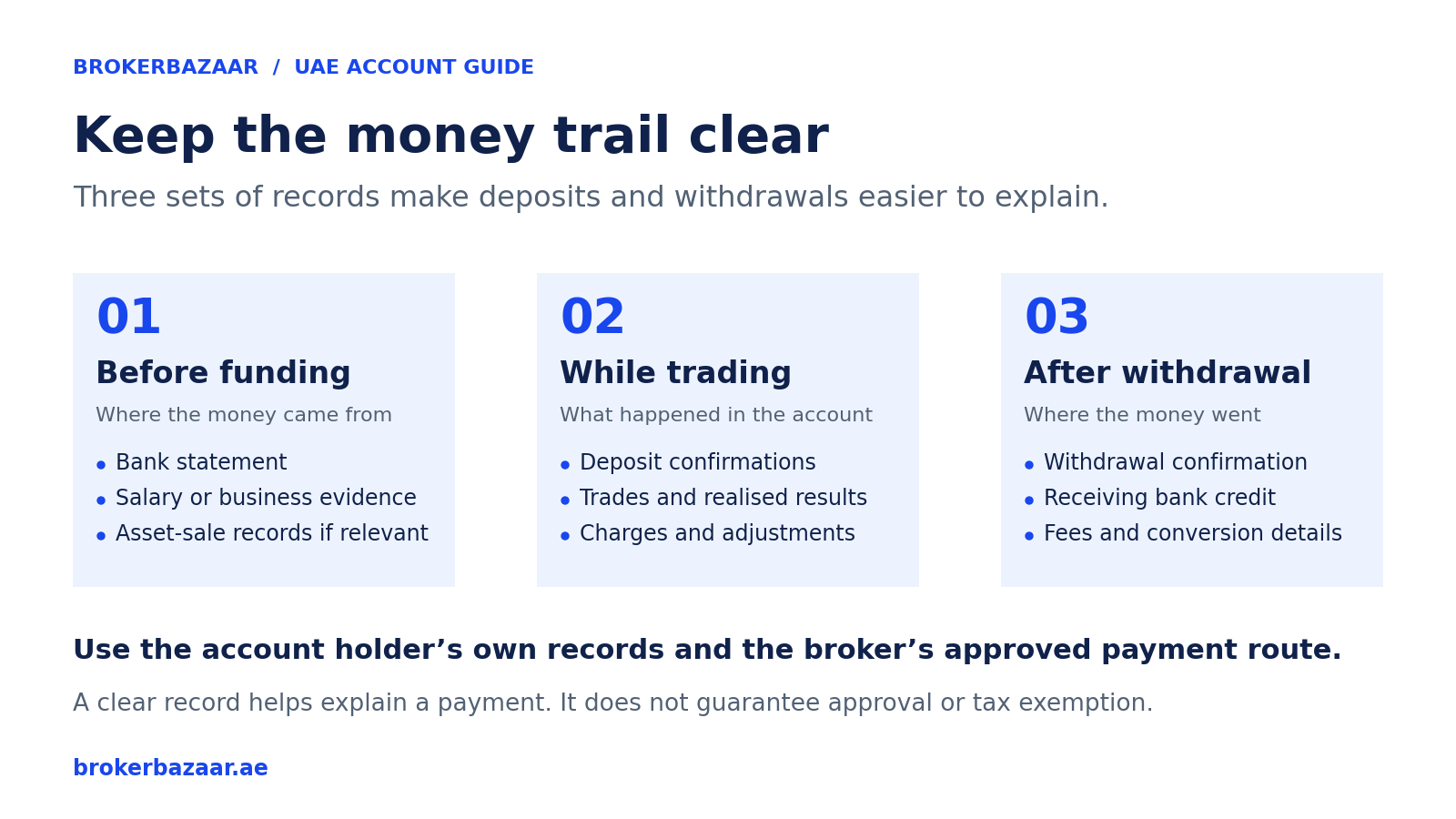
Imagine you deposit AED 50,000. You close all trades and, after trading charges, your account contains AED 60,000. You then withdraw everything, with no further payment fee or currency conversion.
In this simple example, AED 50,000 is your original capital and AED 10,000 is the net trading gain. The AED 60,000 bank receipt is a mixture of the two.
This example explains the movement of money. It does not calculate taxable income or predict a return. With open positions, earlier withdrawals, additional deposits or other adjustments, you need the full account history to work out the result.
How UAE tax rules apply to trading profits
The useful starting point is the nature of your activity, not the amount on the withdrawal confirmation.
Under Cabinet Decision No. 49 of 2023, qualifying personal investment income earned by an individual falls outside UAE corporate tax. The definition concerns investment for the person's own account that is neither conducted through, nor requires, a relevant licence and is not a commercial business under the Commercial Transactions Law. These conditions matter. [7]
A personal trading-account label does not establish that every forex or CFD activity meets that definition. The FTA's natural-person guide explains the personal-investment and commercial-business distinction; it should not be turned into a blanket promise that all forex profits are tax-free. Someone trading as a business, managing other people's money or earning related service fees needs an assessment of those actual activities. [8]
For an individual conducting relevant business activities in the UAE, the FTA identifies an annual business-turnover threshold exceeding AED 1 million for corporate-tax scope. Qualifying personal investment income is excluded from that calculation. The threshold is not a limit on how much someone may withdraw from a broker. [9]
Where the ordinary corporate-tax rates apply, they are 0% on the first AED 375,000 of taxable income and 9% on the portion above it, subject to applicable rules and reliefs. Turnover, taxable income and withdrawals are different measures. Company accounts require their own assessment. [8]
If you have tax connections to another country, obtain advice for that country too. Do not assume that using a UAE broker removes foreign filing or payment obligations. For a substantial or uncertain position, take the account statements and a description of your trading activity to a qualified tax adviser.
Can trading profit count as personal income
For your own financial records, distinguish realised gains, losses, charges and returned capital. A trading profit is not employment salary, and calling it "personal income" does not determine its tax treatment.
If you need to demonstrate income for a mortgage, tenancy or another application, ask the receiving institution what evidence it accepts. Provide broker statements and a reconciliation of deposits, withdrawals and net results. Do not assume that a profitable month will be accepted as recurring income.
The bank receiving a payment may also ask about its origin. UAE due-diligence rules require ongoing transaction scrutiny and current customer information, including source-of-funds checks where necessary. A request for documents does not, by itself, establish a tax liability. [10]
What happens after you request a withdrawal
Look for two separate timings: when the broker processes the request and when the receiving bank credits the money.
CFI's September 2026 UAE terms describe same-day processing, or the next working day for requests outside normal trading hours, while allowing up to five banking days for transfer completion. The agreement also describes circumstances in which outdated KYC records can lead to funds being held pending an update. These are contractual provisions, not an unconditional arrival guarantee. [11]
Costs also vary by route. Equiti's UAE funding page lists no broker fee for domestic bank withdrawals, USD 30 for international bank withdrawals, and 1% capped at USD 30 for Skrill and Neteller withdrawals. It separately warns that banks or payment providers can apply charges. Check the current schedule for your account before confirming a request. [5]
Keep withdrawal fees, conversion costs, trading charges and any tax entries separate. If a deduction is unclear, ask for an itemised explanation and the agreement clause or legal basis supporting it.
If someone asks for an additional "tax payment" to unlock profits, verify the request independently using the broker's official contact details before paying. Request the calculation, legal basis and beneficiary details. A message from an account manager is not enough evidence on its own.
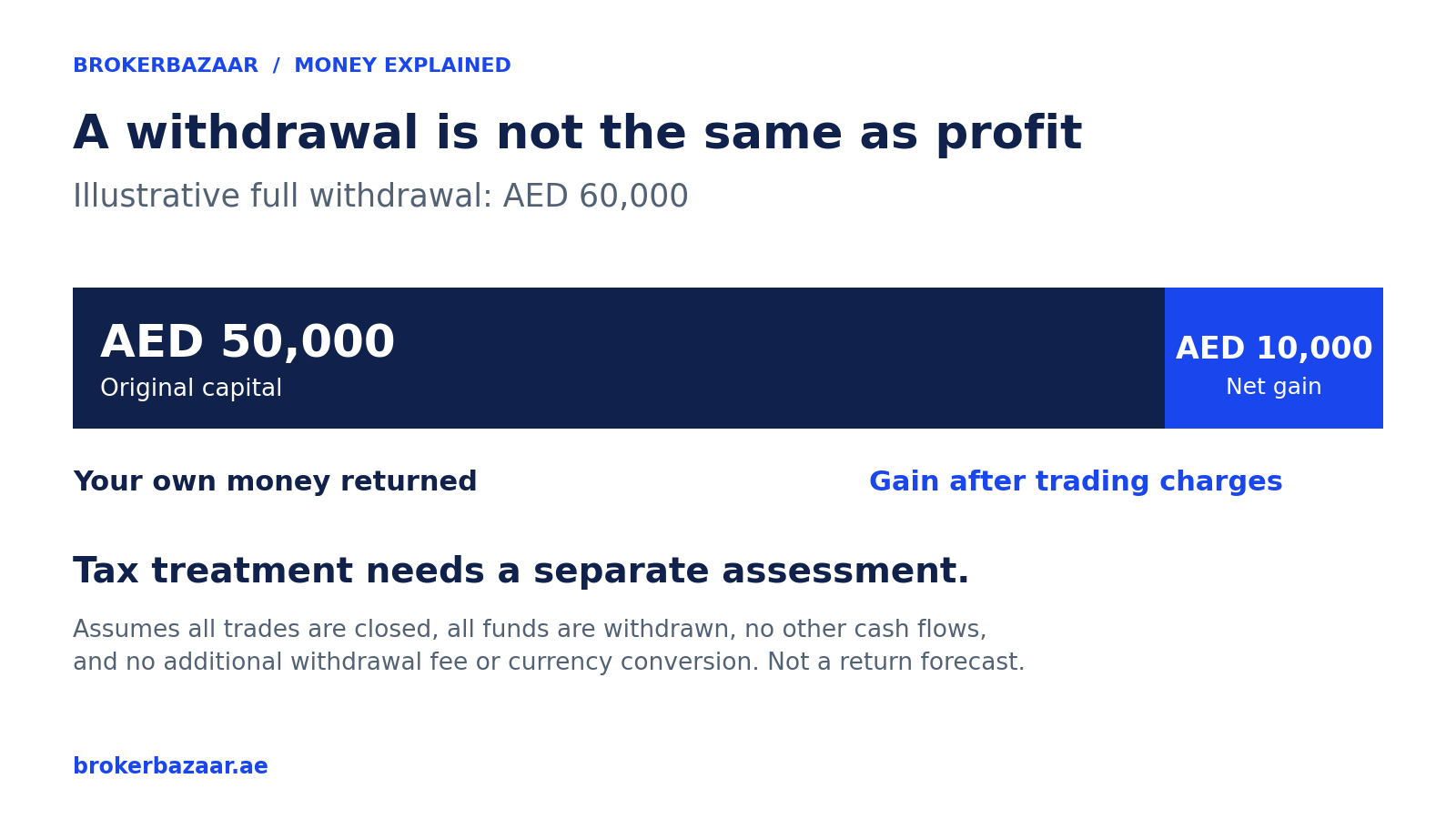
Keep a small folder of useful records
You do not need an elaborate filing system. Keep these documents together and update them when your account details change:
- Your accepted client agreement and the applicable fee schedule.
- Deposit confirmations and evidence of the original source of funds.
- Periodic broker statements and realised profit-and-loss reports.
- Withdrawal confirmations and the matching bank credits.
- Correspondence about deductions, payment delays or changes in personal details.
If a withdrawal is delayed, request a written status, the reason for the delay and the next action required. If support does not resolve the issue, follow the formal complaints policy for the contracting entity and check the relevant regulator's escalation process.
Before you press deposit
You should be able to name the company holding your account, find its permissions, explain the source of your funds and describe how both capital and profits will be withdrawn.
That understanding is useful long before a trade is placed. When comparing brokers on BrokerBazaar, look beyond the spread: read the entity details, payment conditions and documents you will depend on when you want your money back.
Risk and scope note: Forex and CFDs are leveraged products and can cause substantial losses. This article provides general education, not personal tax, legal or investment advice. Policies and permissions can change; check the current agreement and official register before acting. Named brokers are examples, not recommendations.
Sources and further reading
Information checked 27 September 2026. Sources were checked on that date. Broker policies apply to the specified entity and account terms.
- CMA licensed-company records: Century Financial, CFI, ANAX Capital, MENA Capital and Equiti. Also see the CMA register and Category 5 notice.
- ANAX Capital UAE client terms, version 1.2, 16 May 2026, eligibility section.
- ANAX Capital UAE AML and KYC policy, identity and source-of-funds sections.
- Equiti UAE frequently asked questions, account opening and funding sections.
- Equiti UAE deposits and withdrawals, payment methods and published fees.
- Century Financial public terms and payment notice, cash and digital-asset payment restriction.
- Cabinet Decision No. 49 of 2023, Articles 1 and 2; English translation hosted by the FTA.
- FTA guide CTGTNP1 on taxation of natural persons, sections 3.8.2, 3.11 and 3.12.
- FTA basis of taxation for natural persons.
- Cabinet Resolution 134 of 2025 Article 8 in the CBUAE Rulebook, ongoing due diligence and customer information.
- CFI UAE terms and conditions September 2026, section 18, PDF pages 30 and 31.
BrokerBazaar is a technology platform that helps traders and brokers find information, compare options and resolve issues. We are not a regulator, ombudsman, law firm or arbitration service, and we do not determine legal liability or guarantee any specific outcome.